


China's Strong Tech Future
- Jun 8, 2017
- 49 min read
Abstract
Since the 1960s, China’s economy has been rapidly expanding at an average Gross Domestic Product (GDP) growth of about 10%. Although in recent years, the country's growth has begun to decrease. As far as GDP growth is concerned, strong growth is classified as being over 5%. This paper demonstrates how China’s growing technology sector can maintain a growth rate of at least 5% in the years to come for the economy.
Economy & Growth History
China’s modernization and industrialization started with Mao Zedong’s “Great Leap Forward” in 1958. This was accomplished with building over 26,000 communes, which are government created communities of over a thousand-people working to produce various industrial and agricultural products. In total these communes put over 700 million people to work all around the country. Mostly the communes produced steel, coal, chemicals, timber, cement, grain and cotton. The Chinese goal during this time was to increase output exponentially and drastically improve infrastructure in their own country as well as sell it to the rest of the world. This increase in production through the communes boosted the Chinese economy’s GDP by increasing government expenditures, and having a positive net exports, which means a country is exporting more than it is importing.

Government expenditures and net exports increase GDP because of the GDP equation: Y = C + I + G + Nx; this is called the expenditure approach to calculating GDP, which adds up all consumption, private enterprise investment, government spending, and the net exports (exports minus imports) in an economy each year. Algebraically speaking, if there is an increase to any part of the right side of the equation, the left side would have to go up as well. Along with this increase in production, Mao inspired many Chinese people that they could build anything. Mao’s inspiration increased the productivity of the average Chinese worker, and is part of the reason for this large production increase. In economic terms, productivity is a sort of “catch all” variable that includes everything that moves the production function that is not labor or capital (i.e. technology, human capital). Productivity growth is calculated within the production function equation of,
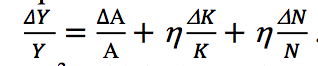
This equation was derived from the production function, Y = A F (K, 𝑌A𝐾𝑁
N), which shows the yearly production curve for a country. The output growth equation shows output growth equaling productivity growth plus capital growth times an elasticity of output with respect to capital plus the rate of labor growth times an elasticity of output with respect to labor. This output growth equation can be rearranged to show what productivity equals,

From this new equation, in the short run, a dramatic increase in production will outweigh the growth of both capital and population, and thus increasing productivity growth. Shown below is an example on how productivity growth will increase:

Elasticities (US): K = 0.3, N = 0.7

2007 (Productivity Growth)
∆𝐴/A = 29.1 − (0.3)(24.7) − (0.7)(0.6) = 29.1 − 7.41 − 0.42 = 21.27
2008 (Productivity Growth)
∆𝐴/A = 29.4 − (0.3)(23.4) − (0.7)(0.6) = 29.4 − 7.02 − 0.42 = 21.96
During the beginning of the Great Leap Forward there was capital growth, but nothing substantial due to the Chinese not using any machinery when harvesting cotton and grain. They used “back-yard” production plants to make steel, chemicals, coal, timber and cement, which required minimum machinery. They were less advanced than what United states steel companies used at the turn of the century when America entered its industrial revolution. Andrew Carnegie innovated steel production after the American Civil War with the Bessemer Process. In comparison to the Chinese, American steel companies were a lot more innovative because the Chinese were using a “back-yard” simple version of the same steel making process over a 100 years later. Population growth, in the short term (one to two years) is not particular high; overtime is where population growth is more of a major factor. In the short-term population growth is not high because with a growth rate of 1.5% (approximately China’s population growth rate from 1960 – 2015) is not a huge increase over one or two years. Although, after 30 or 40 years with a 1.5% growth rate brings a significant population increase. This concept is the same principle as compounding interest over time. Particularly in China’s case, during 1958-61- time period, population growth was slowed considerably because of a major famine that wiped out nearly 45 million people in the country. This famine was caused by the country not producing enough food to go around. This was due to the fact of having several floods and droughts during 1958-61 that wiped out a portion of crops. Furthermore, because of China’s communist government, they implemented a rationing system, which gave people very little food. Overall the Great Leap Forward was surrounded with failures including, poor weather, a major famine, and poor allocation of resources. One of the most prominent poor allocations of resources was not having enough coal to power their train network because the “back-yard” production plants were using too much coal.
Although, the first attempt at modernizing China to compete with the United States was a failure, they had the right idea - China needed to produce more. Table 1 shows the average GDP growth for the years 1961 - 1976 for China; the table also includes India, the United States, and the World for comparison.

This GDP growth was made with investments in physical and human capital. Growth in capital and labor, directly increases production, which in turn will increase a nation's GDP. One factor that suffered during this time was the productivity. Up until 1976, China was led by Mao Zedong with a command economy. Mao’s China was very isolated nation that did not trade a lot with the rest of the world. Inside China, the government did not allow outside enterprises to conduct business inside the nation. All allocation of resources was decided by the government; this means that the government decides what the country produces, exports, imports, and what its citizen can produce. For a communist command economy, this is normal, modern day countries such as North Korea is a more extreme example of this economy type. Due to the nation being centrally planned, productivity suffered because workers were given no incentives to work. This was often a problem in communist countries because every citizen was generally given the same ration of food and pay. When everyone is getting the same thing no matter what, it eliminates productivity.
Productivity growth is a part of the production function (A), Y = AF (K, N), which can be rewritten as Y = AK^(α)N^(1-α). As China’s GDP, or output, increases this can be attributed to productivity, which growth has been explained earlier in the paper. Although this is not always the case, and China’s high population growth has contributed to a lot of each year’s production. Compared to the rest of the world between 1960 and 1976, China’s population growth rate was on average 0.5% higher at 2% than the world’s population growth rate of 2%. With population increasing so rapidly does not always lead to an increasing amount of output; in other words, the diminishing returns (also called law of variable proportions) will eventually lead to a decreasing amount of output as population increases to a certain amount. Keeping K (capital) or N (labor) constant, according to the formula, would yield a formula of Y = AK^(α) or Y = AN^(1-α). And this would show a graph at looks like:

The slope of the production functions the marginal product (depicted as MP on the above graph) of labor (or capital), which tells the increase in output (Y) produced because of a one-unit increase in labor (or capital). Also, a part of the slope worth mentioning is how the first third of the graph shows the MPN or MPK having increasing returns. Then, the middle shows an increase with diminishing returns, and the last part is decreasing returns for each additional unit of labor (or capital). Generally, developing nations tend to be positioned in the beginning to middle of this graph (Stage 1 on the graph). This is because they have not yet achieved the point where it no longer makes sense to gain additional labor or capital to produce more production. In other words, developing nations returns on output would be negative. Some developing countries could include China, India, and most African countries (Rwanda, South Africa, Kenya, et cetera). Developed countries, such as those in western Europe and the US, tend to be more around that ideal point where it no longer makes sense to gain additional labor or capital to produce more production.
Having said all of this on the production function, China in the 1970s and ‘80s attempted to slow down their population growth. This was accomplished by putting in place a one-child policy, which means each family is only allowed to have one child and are penalized for more than that. This was to ensure that the population would have a decreased rate of growth from what it previously was. According to the World Bank’s data on population growth, China’s annual population growth rate decreased a full percentage point from 2.7% in 1970 to 1.7% in 1975. In the first couple of decades this has worked well in urban areas where it is easiest to enforce. Although, in rural areas where most minority groups were living in the country, the one-child policy was not so quick to implement. Altogether, this policy, that has also been dubbed “one is best, two at most, but never a third,” has been successful when looking at the data; this success has been measured by how much the annual population growth has decreased since the policy implementation. Although the policy has been highly controversial in the methods the government has used in its implementation. Eventually by the year 1995, China’s birth rate had come down to about 1%, which is relatively low compared to the world’s average birth rate of 2.3%. Today, China is the most populated country in the world at 1.3 billion people, following closely behind is India, also at 1.3 billion people. China has grown from 660 million people in 1960, which is twice America’s population today. China’s population is forecasted to be about 1.4 billion by 2050. These predictions show that China is slowing down and getting its economy to a developed state. Developed state means that a nation has went through its industrialization period where it is having advanced technology when compared to other developed countries. Developed countries, by definition, mean they are richer, and therefore allows these countries to produce, buy, and sell more things with more advanced technology.
Table 2 compares the historic GDP of China, India, and the United States. As shown in the table, China’s GDP tripled from 1960 to 1976 when the country first started its industrial revolution. China’s 300% growth in these 16 years compares to India’s 177% growth, and America’s 245% growth. And in the last 39 years (1976 - 2015), China’s GDP has increased approximately 7000%, India had a 2000% increase, and America had an increase of 860%. India and China’s increases make sense because both countries are industrializing, as opposed to America, which is far past its industrial revolution.

How Chinese Fiscal and Monetary Policy Have Shaped Their Economy
Post 1976, China has finally started to become the world's manufacturing center due to the number of available workers, cheapness of labor, and few regulations (compared to the United States). Now, China has slowly become more open to trade with outside nations and ease out of their self-sufficient policies they have previously been in under Mao Zedong’s rule. Following Mao’s death in 1978, Deng Xiaoping became the new Chinese president. One of his first fiscal policies was to launch what he called “the Four Modernizations” to catch up to the United States. These four modernizations included: agriculture, defense, industry, and science and technology. This started with Deng breaking up the failed communal farms that were started in the Great Leap Forward, they advocated entrepreneurship, and created special economic zones around the country for their state-owned companies. These special economic zones are areas within the country that have different laws and regulations for public and private enterprises to operate under. Furthermore, in 1980, China joined both the International Monetary Fund (IMF) and the World Bank.
These policies helped open the Chinese economy to become increasingly more dominant in the world economy. Advocating entrepreneurship was one of the ways to do this because it helps encourage innovation, which drives productivity growth. As discussed earlier in the paper, productivity growth is one of the factors that drives output (or GDP) growth. Special economic zones also will help give incentives for workers working in government-owned companies. These zones will help create incentives because the state-owned, and private, companies will compete against each other in their zones. An economic zone like this is a set area within a nation, which include positives like: job creation, an effective and efficient administration, and increased investment and trade. Also, being in the IMF and World Bank enables global cooperation through trade, financial strength, and sustainable growth. Both organizations offer economic data from almost every country in the world, and store that data so it can be historically compared.
The third generation of the Chinese Communist Party was born with President Jiang Zemin and his administration as its head. During this time, Jiang also took large economic reforms to help and grow the Chinese economy even more. In the 1990’s, the Chinese economy was only $360billion, compared to the $6 trillion American economy. China still had a long way to go to catch up to the United States’ economy. The first mandate was to privatize or liquidate most of the state-owned companies, except for large monopolies such as water, and electricity. One result of this is that is increased investment spending and an increase to net exports (meaning an increase to exports to countries outside China). Although, one downfall of this mandate was that it left millions of Chinese workers unemployed. The unemployment rate in the early 1990s averaged 4.4%, but by the end of the 1990’s it increased to 4.7%. This is not a huge increase compared to a depression, although with how big China’s population is, 1% was approximately 11 million.
Other economic mandates Jiang put in place were directed at the private sector to be able to produce more, which would lead to them making more and investing more. The first decreased trade barriers with the rest of the world. This made it easier for the world to buy Chinese goods, and China to buy the world’s goods from previous decades. Thus, would increase GDP because net exports would increase, assuming China would sell more than they would buy. The second mandate ended state planning, which means that firms no longer had to follow the operational guidelines set by the state. This would mean firms could expand how they wanted to and not have to worry about major government interference in how they were operating. As a result, this would increase profits and investment spending for the business, which would increase output (GDP). Third, competition was introduced into the economy. With competition, companies have more incentive to innovate and make their products better and more attractive to the consumer. And innovation leads to an increase in technology, which is part of productivity, and thus increases GDP. Fourth, Jiang rolled out many deregulations to the economy, which allows firms to not spend as much adhering to the government's rules to how to run an industry. Also, in 2001 President Jiang helped China join the World Trade Organization. The WTO is the only international organization that deals with the rules and regulations that surround international trade agreements between countries. It is their goal to make international trade go as efficiently and smoothly as possible throughout the world.
The last part of Jiang’s presidency had to do dealt with the 1997 Asian Financial Crisis, also known as the “Asian Contagion.” The crisis began in Thailand when they decided not to value their own currency, the baht, versus the US Dollar. Due to the baht, not being valued at the US Dollar, it declined and that made most other far eastern Asian currencies to fall as well, including China’s yuan. With currencies declining in value (and inflation increasing), this caused Asian and other international stock markets to fall as much as 60%. As inflation rises due to a decrease in the value of money, money demand will decrease because people do not want more money that is not worth as much. This decreased value of money was caused by investors becoming more uncertain on the currency since it was no longer being pegged to the US dollar, which, at the time, represented the strongest currency in the world. This will cause the money supply-money demand (LM) curve on the IS-LM model to shift down causing a decrease in the real interest rate. To fix this, the International Monetary Fund (IMF) and the World Bank stepped along with many countries governments to bail out banks. When a government bails out banks, it means that the government is giving them a large portion of money to not fail. This money that is given then is used to spend back in the economy to increase investment (through the company buying capital) and consumption (having the company give bonuses to employees for them to spend). With increases to investment and consumption, this would increase the investment- savings (IS) curve, thus raising real interest rate.
In the 2000’s Jiang Zemin stepped down from being the General Secretary of the Communist Party. After Jiang, Hu Jintao became the next president, and Wen Jiabao became the next premier. This new Hu-Wen administration became China’s next leaders, which became fourth generation of leadership in the Chinese Communist Party. Hu’s economic reforms tried to correct the income gap between urban and rural China. There was an income gap because the past 50 years of industrialization had majorly affected urban China, but not rural as much. This was due to the fact of China’s topography because most of China’s landscape is filled with desert, mountains and is just large. These topographic challenges make it very expensive for a developing nation to even the income throughout the whole country. Also, rural China was made up a lot of minority groups, which were discriminated against by the Chinese. These reforms were targeted to get rid of taxes in the agricultural sector, which will make it so workers will have more money to either spend and save. An increase in saving, consumption, or both would increase total output.
The second reform was to slow the privatization of state assets; privatization is the transferring over of assets from the state to the private sector of the economy. By slowing this privatization allows the Chinese government to maintain low prices for the Chinese consumers because in the private sector corporations will try to make a profit, which tends to be by raising prices. By doing this for rural China, which is poorer, will allow people to save more and consume more with their increased income (because of the tax cuts), so that they would be able to handle an increase in price in the future. For example, in an IS-LM diagram, the Investment-Savings (IS) curve would shift up and to the right along the Money Supply-Money Demand (LM) curve due to the increased output from the increase in consumption and savings. Then in time, the markets would self-correct back to general equilibrium with an increase in prices; in other words, the LM curve will move up and to the left along the IS curve back to the FE line. This would also translate into an increase in the aggregate demand (AD) curve on the AD-AS economic model. The third reform made under Jiang’s leadership was the promotion of social welfare. Social welfare is part of human capital, which is included in productivity, and is when organizations (public and private) do beneficial actions within the community that promote prosperity.
The fourth and final reform made by Hu’s administration was to increase subsidies. A subsidy is a portion of money given by the government to aid an industry, company, or organization within the nation’s economy. These subsidies help the private industry to invest in various kinds of capital that they may need. This would be another factor that would increase the IS curve, and therefore would also increase the AD curve. These major reforms have been targeting increasing productivity growth, since Mao’s rule, productivity was lacking because of the fully command style of government. From the 1980’s to present day, China has opened more and more up to direct foreign investment and foreign trading to increase their growth as a nation to catch up to eventually compete against the United States.
With these reforms in the 1990s and early 2000s led to the mid-2000s tremendous output growth. This growth came from major increases in all areas of the output equation (except government expenditures), which are consumption, investment, and net exports. This was likewise in the United States, up until the 2008 financial crisis. This happened due to the housing bubble in the United States popping, banks losing billions of dollars, and having Lehman Brothers, a bank in New York City, fail. This crisis practically made the entire world fall into a recession due to the United States being the only world superpower. Because of the Chinese stock markets also crashing, the Chinese government had to put together a stimulus package to revive the economy from the crash. Like the United States’ economy, the Chinese economy took a few years to recover from the recession. This also made the Chinese government adopt a looser monetary policy, which is when the money supply in an economy is high and is readily available for the consumer. This encourages people to spend more money, which increases consumption and thus grows the economy.
In 2012, the Communist Party of China usher in their current president, Xi Jinping and Premier Li Keqiang. Like past administrations, the Xi-Li administration issued a series of reforms that targeted sustainable growth for the country. At this point, China was about at the point in the production function where they are still increasing in production, but with diminishing returns on capital and labor. Because of these diminishing returns, the Chinese government must become used to seeing decreasing growth numbers, and they have grown accepting of it. In the past few years, the Xi administration wants to shift Chinese growth away from being investment driven, and be more consumer demand driven. This means that the Chinese government does not want to invest in as many factories anymore, and they want to concentrate more on consumption spending of the Chinese people. As a country’s economy grows, its people become wealthier, and this reflects on the country’s GDP per capita statistic. GDP per capita is the total output produced in the country (GDP) divided by the country’s population. To put simply, GDP per capita is the average of the entire population’s income. Therefore, the greater the GDP per capita, the higher the standard of living. Table 3 shows China, India, and the United States’ GDP per capita for four years.

With China’s current population, their GDP per capita is understandably low compared to the United States. If China had the United States’ population of about 300 million, their GDP of approximately 11 trillion USD, and today that would translate to $37,000. The United States’ GDP per capita was at $37,000 back in 2001. Mathematically, for China to have a GDP per capita equal to $54,000, with the same population, their GDP would need to be $70.2 trillion. Table 4 shows how many years (and what year) from 2015 it will take for China’s GDP to grow to $70.2 trillion.

Although it is unlikely for China’s GDP to maintain an average of 7% or 8% up until the 2040’s and 2050’s. Seeing the math on the growth rates drawn out shows that with China’s large population, it would still take a long time to achieve the GDP per capita that the United States has today. This shows, on average, how much wealthier an individual American is compared to a Chinese person. And these calculations make sense, it takes time for an economy to grow to a fully developed state, like the United States’ for example.
Throughout the years of growth, China has propelled itself from a middle of the pack country (in terms of GDP) to the second largest economy in the world behind the United States. Part of the reason as to why they have done this is by shifting their economy to being more capitalistic in nature. Although they are still run by a communist party, compared to 30 years ago they have made great strides to open their economy to competition, exports and imports, and allowing private enterprise. This is not the communism Karl Marx envisioned in the nineteenth century; which advocated for class war and leading to a society in which all property is publicly owned and each person works and is paid according to their abilities and needs.This is what Mao Zedong wanted the country to look like with his Great Leap Forward, but this, as discussed earlier, has its issues with growth. Since 1978, China had shifted its government style to be more command socialist than communist, and its economy being capitalistic with government intervention. Similarly, to a changing government style, rural versus urban inequality in the country is also trying to change as well.
Rural vs. Urban
Topographically, China is a big country with many different geographical including deserts, forests, mountains and rivers. Throughout China’s industrial revolution the divide between people living in rural versus urban. One measure to calculate this inequality is the Gini coefficient, which is a value between 0 and 100 that reflects the distribution of family income in a country. A country having perfect equality means that the Gini coefficient is 0 for that country, and it would then mean that perfect inequality is 100. As of 2012, China’s Gini coefficient has been 42.16. According to statistics by the United Nations University, income inequality has been on the rise since the 1980’s in China. The highest income inequality difference in the country comes from regional discrepancies being 12% across Chinese provinces. In the United States the regional discrepancy only accounts for 2% across states.This rising inequality essentially means that the rich are getting richer and the poor are getting either poorer in
comparison. It is possible that the poor are getting poorer and rich are staying the same to increase income inequality, but with a growing economy like China’s that is simply not the case. In many developing countries, the income gap can become too large because the government has not yet placed minimum wages, regulations, and adjust taxes accordingly.

In comparison, the average Gini coefficient for the developed western European is approximately 25. On the other hand, countries that are in the developing stage, such as sub- Saharan African ones have a Gini coefficient of about 50 to 60. China’s income gap is still higher than what is ideal, but their economy can still be considered in the development stage. One other factor that must be considered is China’s population because it is going to take longer for a country with one billion population to lower their Gini coefficient. China is currently one of two countries with over one billion people (India being the other country), and the third most populous nation is the United States with 320 million (nearly one billion less). The reason why this makes such a big difference is because 10% of 1.3 billion is 130 million, or about one third of the United States’ population. Likewise, 10% or 320 million is only 33 million, 100 million less. The numbers being worked with in accordance to their population and the gini coefficient are so much larger than those of western European countries whose largest population is 82 million in Germany.
In China, their major cities (Beijing, Shanghai, Guangzhou, and Hong Kong) are all coastal cities along the country's east coast. The numerous rivers and relatively flat terrain allow this the best place for industry to begin in the country. With ports, you have access to ship products to any corner of the world, and through a railway system it is easy to transport goods to eastern Chinese cities. During the American industrial revolution, a railway system was crucial to how America industrialized. It allowed quick transportation throughout the mainland US, from Los Angeles to New York in only a few days. This was a massive improvement from the pre-railway days where it would take up to a month or longer to go cross country by horse and carriage. This increased the efficiency of how fast products could be produced and then shipped in greater quantities to buyers. And thus, with greater quantities being produced and sold, GDP in turn would then increase, this would mean consumption, investment, and net exports could all increase. Unlike the United States, China’s rail system does not stretch to all sections of the country, and mainly stays in the east (with a few lines going west towards Urumqi). Also, unlike the United States, China does not have two oceans on either side of their country. China has the Pacific Ocean to their east, and to the west are the world’s biggest mountain ranges including the Himalayas, Qinling, and Kunlun. To further make western China harder to live, it also has the 270,000- square mile Taklamakan Desert in the Xinjiang province north of Tibet. With these barriers that make it very difficult to build infrastructure to bypass these wide mountain ranges. As a result, most of the country's industrialization stayed in the eastern half.
The largest and most populated region in western China is the province of Tibet. Back in the 1950’s China took over the country of Tibet, although the local Tibetans still have the belief that they are not a part of China. In 2012 Senator Robert Menendez, Chair of US Senate Committee on Foreign Relations said, “Tibet today is one of the most repressed and closed societies in the world.” This takeover of Tibet was almost purely economical and strategically by the Chinese. Tibet offered a great deal of resources in its land including: copper, lithium, gold, silver, oil, water, zinc, and various other raw materials. One of the most important resources Tibet has is its water, which is considered the third largest source of water-ice in the world.This source of water supplies the Indus, Ganges, Yellow, Yangtze, and many other major Asian rivers that go through almost all the countries south of China. Like the other resources in Tibet, water can be exploited and used to produce hydroelectric power for the eastern Chinese megacities (Beijing, Hong Kong, et cetera). Economically, having Tibet is obviously a plus for China because they would be able to produce and sell a wide variety of products and materials. Subsequently, increasing output and growing the economy.

Although, the ones who lose from this are the Tibetans who have had their government overthrown and their leader, the Dalai Lama, ousted from Tibet to India. The Tibetan people have attempted protests numerous times through the years, but none have been successful. The Chinese government has implemented strict rules on the people of Tibet, including flying and showing the flag of Tibet, sending an email abroad, or saying any phrase like “human rights.” Essentially, Tibetans are treated as second class citizens to the Chinese, and are have been ranked in the top four most repressed countries in the world.
Looking at repression from an economic standpoint shows that in no form does limiting people’s freedom lead to any sort of productivity growth through, raising meaningful human capital, or innovation. If there is no incentive for workers to work harder, or develop new technology, then people most likely will not do it. If a person is subjected to second class privileges and discriminated against, they will do the bare minimum for their job; and that is not how you grow productivity. To add to this repression, the Chinese do not hire the local Tibetans for jobs, which increases poverty and unemployment in the area. It is hard to calculate how much poverty and unemployment this translates to in Tibet due to China banning western media and censoring a lot of information in the country. Also, the Chinese government has been known to falsify some of their data calculations on output, consumption and items similar. Today the international community does not recognize Tibet as a separate government from China, even being aware of the repressed society there. A reason as to why there has been no government intervention in the region is because when China took over Tibet was in the 1950’s after World War two, which itself ravaged most of the world. And even if WW2 never happened, China was not a country that provided much benefit for nations abroad. In other words, there was not much the international community would get out of an engagement with China. Furthermore, from the 1950’s to present day, if someone did intervene and declare Tibet their own sovereign nation, then they would have to deal with one of the largest governments in the world; and most likely be cut off from trading with the largest manufacturing countries. Having an outside nation deal with China and Tibet is too costly for any nation to do, the negatives outweigh the positives tremendously. To conclude, China is not going to acknowledge Tibet as their own independent country any time soon given their resources. Also, the Chinese government should be taking steps to provide and show that the local Tibetans have equal rights as a first step to attack the racism of the Tibetans culture by the Chinese people. Having said all of this, the geography of the region would make it ten times harder because the easiest way to get to Tibet is through mainland China.
Even though in China’s constitution it states how everyone, regardless of any differences (gender, ethnicity, religion, et cetera), is equal and has the same rights, there is still a great deal of discrimination and racism in China today. In such a large country, there is bound to be a large variety of ethnicities with different beliefs from one another. Two of the largest minority groups occupy almost all western China, those two being Tibetans and Uyghur (mainly in the Xinjiang province north of Tibet). There are a good number of minorities that are not as big as the Tibetans and Uyghurs. Most Chinese people are Han, and about 90% of all Chinese people have some bit of Han Chinese in their genetics.
One of the main reasons this divide has been happening is because of how difficult it is to get from the countryside to the urban cities in the east. There have been railways in place in China since the turn of the twentieth century, but those early railroads were very limited in where they went. The early railroads mainly went to the major east coast cities (Hong Kong, Shanghai, and Beijing). During the Great Leap Forward to the 1970’s the Chinese made a more concerted effort to build up their railway system to connect the country and be able to transport raw materials and finished products throughout the country. This system has stayed roughly the same since the 1970’s with some improvements and additions. Since this railway system did not go to a lot of rural China, people living in rural areas did not have access to the new products being produced by the country. These people did not have access to the same amenities as people living in urban China. In other words, the urban economy of China was growing at a faster rate, and being able to make more money than the rural economy. Generally, assuming MPS and MPC remains the same, when people’s income increases, then they will save and consume more. When savings increases, both Solow’s “steady state” growth model and the endogenous growth model suggest that living standard will increase. Because of this, urban China has a better standard of living than rural China.
Although, China is trying to lower the income inequality in rural versus urban China. In 1999 – 2002 when China’s current President Xi was governor of the Ningxia province in central China west of Beijing; he implemented an anti-poverty campaign that started in the small town of Minning. Ningxia was a mostly rural province in the mountainous Chinese landscape. The local government tested an anti-poverty method that gave jobs to people who were deemed under that poverty line. In rural China, the local government classifies the poverty line in the area to be 3,200 yuan per year ($465 per year), and this program pays 20,000 yuan per year ($2,900 per year). This poverty line, compared to the rest of the country, is approximately 40% above the national poverty line. Minning is considered a “model town” to this program, and has employed about 410 people that were previously below the poverty line in the area. Another part of this program is the full disclosure to who, and how, the government is helping the citizens. Xi created this plan to individually help each person below the poverty line to plan. By going on an individual basis instead of just giving money out to people that are classified as poor makes sure the money is going to people in actual need. This poverty reduction system that began in Minning has spread throughout China in rural areas. It is also worthy to note that this system based on helping individuals create plans mainly works in the countryside where there are not as many people. In the city, this system has not been adopted to the extent, this is due to the fact of the greater number of people in cities compared to the countryside. Although, by the Chinese governments standards, poverty has nearly been eradicated from the urban environment. Part of the reason the government may say this is because the poverty line in cities are much higher due to the higher standard of living. Since the poverty line is higher in urban areas than rural ones, the government thinks that that line is good and people can afford the items that they need in urban areas. In other words, due to higher prices on goods and services, people will earn more for working to be able to afford various good and services being sold.
Over the past few years, China has been doing a good job at reducing poverty in their cities and countryside. According to an article in The Economist, there were 775 million people below the poverty line of 2,300 yuan in 1980, and in 2016 there was only 43 million below the poverty line. China’s current administration, under President Xi has made poverty reduction one of the main matters to deal with while he is in power. One of the main challenges to lower this 43 million number even more is that approximately 46%, 20 million, of China’s poor are poor due to their health. To combat this, China adopted a registry program that both the Philippines and Mexico have adopted and found success with. This registry program is a poverty reduction program that helps give the poor money and a plan to lift them from being poor. This system has been named dibao, or “substance guarantee,” and has been largely inefficient due to corruption in its beginning years. Part of the reason as to why there has been so much corruption in the program is because it is financed heavily by the national government (0.5% of GDP), and the local governments were given the task to carry the payments out. Although, due to a recent crackdown in corruption, the program has been improving, but has a long way to go to be considered very efficient form of poverty-reduction. With these reforms mainly aimed at rural China, by 2020 President Xi should be able to reach his target of 10 million or less. Doing this would decrease income inequality in rural versus urban China, and therefore decreasing the standard of living inequality between rural and urban too.
One way to solve this discrepancy between living standards is building infrastructure that makes it easier for Chinese to be able to connect with the rest of the country and the world. This means to effectively get the new products produced by the country to more customers faster because the Chinese would take less time to get to the store than before (speaking for the rural community). China plans to expand their high-speed rail system by 2020 by more than two-thirds, which is equivalent to 4,300 miles. This high-speed rail system plans to connect every Chinese city with over half a million population at the time. Also, currently approximately 54% of China’s population live in an urban environment, and in a recent study conducted by the World Bank, this number is estimated to increase to 71% of China’s population by 2030. With 71% in an urban environment, with China’s current population of 1.3 billion this would mean about one billion people would be living in Chinese cities by 2030. With this many people in cities, it makes access to stores and being able to see businesses advertisements easier for people to see. In other words, it makes it easier for technology companies to get people to walk into their stores, or go on their websites and buy their products.
For technology companies, bridging this gap between urban and rural is good. In an urban environment, it is cheaper and easier to do business, get people to buy, and easier to track what consumers will want next. Compared to a rural environment, companies must lay down miles upon miles more cable, put down more cell towers, or have more offices. And this is just to accommodate a small portion of the market. From the business standpoint, it would make more sense in just operating in cities than to include rural areas in their network. This is apparent with cell coverage in the United States, the best coverage from almost all major carriers is in the major cities. And having decent coverage in most of the other areas of the country. This is also applicable in China, but not just to the cellular industry. Other companies include: cable, television, internet, and electric.
Now, with this increasing urbanization China must figure out the best way to build cities effectively. As of 2014 China has 72 skyscrapers in their cities opposed to only 43 in United States’ cities. This growth is in the hands of both the government to urban plan effectively and the companies to plan the most efficient use of their resources to achieve the most revenue. For a healthy expansion, China must plan for over a billion-people living in their mega cities, and plan to reduce pollution. A clean and efficient future is what China should be aiming for healthy growth because currently they are the world’s number one carbon dioxide emitter. This is twice as much from the country in second, which is the United States. Besides industry, the largest carbon emitter are cars, and the best way to combat this is to design cities to fit public and private forms of transportation. Examples may include, subways, buses, metro systems, and bike paths. To do this, China has a few options, the first is to have the government build it on their own. The second option would be the government giving subsidies to the private sector to build a privately managed transportation. And the third option is having both public and private modes of transportation, which might be the best option. A purely private transportation sector forces prices high due to high investment, increasing the aggregate demand (AD) curve higher. Having a purely public transportation network discourages competition and eliminates the ability for firms to grow in this area. Although it is also worthy to note that having a purely public transportation would increase prices in the AD-AS model by increasing government expenditures. This of course would only be the case if government expenditures do not counterbalance private investment in the GDP equation so that there is no change. But not as much as an investment increase would because the government does not set prices to make a profit like businesses do.
Currently, China’s President Xi wants to implement reforms that are aimed at the healthy and sustainable growth of China’s cities. These reforms are made to get more people into cities, getting rural farmers to sell their land and move to the city. Although, right now this is simply cannot happen because of the income inequality between rural and urban. Part of this inequality stems from the property right differences; land in cities tends to be worth more than rural land. Xi’s solution is raising what rural land is worth in China, this would allow the rural Chinese folk to sell and use that money to move to the urban environment. This would be done by selling the land to the local government, which in turn would use the lane, or sell it to businesses and developers. Although, to be able to sell to the local governments, President Xi must make sure the local government's finances are in order. In other words, make sure there is enough money to be able to buy the land, and then evaluate the land to determine the best next move for that land. In a developing nation, it can often be hard to control local governments finances, and make sure they are all correct and there is no fraud or corruption going on.
President Xi also has problems internally in urban China. These include social discrimination by urban born Chinese to migrants and rural born Chinese. Discrimination is not something that goes away overnight, it takes time to teach people the right thing and be able to show that. Having the courts and law enforcement crackdown on discrimination is one step towards this problem. This is not always the most efficient way, that being teaching and promoting equality through advertisements, videos, and schools. Another problem stems from the uncertainty of the growing middle class. The Chinese growing middle class is facing uncertainty at what to do with rising prices in the urban market. The rising housing prices, they are concerned at how they will afford the increasing prices, and what to do if the housing bubble bursts. One way to reduce this housing price uncertainty is having the Chinese Securities Regulatory Commission (CSRC) watch for fraudulent trades in the Chinese financial market. Another thing to deal with the middle-class uncertainty is to educate the Chinese on how to save better for the future, and setting up various government and private accounts to promote saving for either retirement, college, or a simple vacation. Lastly, President Xi must become increasingly comfortable with decreasing growth rates due to a labor supply that is becoming more constant. Planning for a healthy and sustainably future as a developed country must be Xi’s goal for China right now. China’s population forecasts have their population being at only 1.4 billion by 2050, which would mean China’s one child policy would have been successful at slowing population growth for the long-term.
Future Chinese reforms should plan for slower economic growth for the country. Although, this does not mean for emerging industries within the economy to plan for slower growth. The Chinese economy has been showing signs of slowing down compared to the growth it has shown in the 1980’s, 1990’s, and 2000’s. One of the major signs of economic slowdown has been China’s declining annual GDP growth rate. The technology sector is not an industry where China wants to slow for growth. Even in the United States, the technology sector is still growing and finding its place in the economy.
China's Tech Sector
In recent years, the Chinese electronic technology sector has shown tremendous growth. Over the past 10 years the total returns performance for the tech sector has been over 300%. This total return is a means of measure that includes interest, capital gains, distributions realized over an amount of time, and dividends. It is the actual rate of return of an investment, or a bunch of investments, over a given time of evaluating. This magnitude of growth by itself is phenomenal, there has been huge success with these Chinese technology companies. When evaluating the Chinese tech sector, one factor to consider is the price over earnings, or P/E, ratio. The P/E ratio can be used to evaluate whether a company, or industry, is growing, or making money. Approximately 25 average for a P/E ratio is good for a market to have. Typically, the higher the P/E ratio is, the more growth is going on in the market or company. As of the beginning of April 2017, China’s technology sector’s P/E ratio was calculated to be 54.70. With this high P/E ratio, to investors it shows that the Chinese technology sector is still growing and producing profits steadily for the past few years. Profitability is shown by the sector’s EBITDA margin, which for 2016 is 11.1%; this means that 11.1% of the sectors revenue produced is profit. The higher the EBITDA margin, means that there are less operating expenses to cover the revenue. This is a healthy amount that shows that the sector on average produces good profits and are not losing money or breaking even. Furthermore, in the last twelve months (LTM) $161.6 billion worth of technology products were produced in the world. Over two-thirds of that amount, 69.7% was produced by China, which is a 2.1% increase; compared to the United States only producing 8.2% with a -4.8% change, and India only producing 1%, with a -3.2% change.The main reason as to why China produces the clear majority of the world’s electronics is because US companies doing business in China. Many US technology companies, such as Apple, Dell, and HP. These are some of the largest US technology companies and provide very big business in technology manufacturing; for example, Apple’s produces most of their products in China, which includes their best-selling iPhone. The main reason as to why American companies are producing is because manufacturing and labor costs are far lower in China that in the United States. Although, in recent years China’s wages are rising with their rising prices (CPI inflation rate averages approximately 2% for the past year) makes other Asian countries have a better comparative advantage for manufacturing jobs than China does now. Companies will do this to minimize costs, and thus maximizing profits, they will do this by finding what countries have the best manufacturing costs for them to do this. Although with a decreasing comparative advantage for manufacturing jobs (i.e. making clothes, shoes, et cetera), China has been growing for making technology products (i.e. phones, software, computer parts, et cetera) of all kinds.
Currently in China there are five standout technology companies: Alibaba, Tencent, Baidu, Huawei, and JD.com. These companies are some of the largest and most well known in China and the among the world. One of the reasons these companies have grown so quickly is because of China’s large population based in cities. Cities are the easiest access to millions of people at one time, a single advertisement can reach many more people in an urban area than an advertisement in a rural area. Subsequently, by reaching more people, more people will know about a company’s products and therefore more people will buy their products (in theory). Even though none of these companies are as big as the biggest United States’ companies, they have a homeland country that is over four times the size of the United States. As hopefully this paper will explain, there is still a lot of room for growth for Chinese technology companies in an always changing sector of the economy.
Founded in 1999 in Hangzhou, China, Alibaba is an e-commerce company that helps provide the necessary technology and infrastructure to businesses to ship their products around the world. They do this by providing services, and digital software products to help businesses can sell and organize their products in their own warehouses and Alibaba’s own warehouses. Furthermore, the company also has a website where consumers to go and buy practically anything they need. Practically, the equivalent company in the United States to Alibaba is Amazon. Although, Alibaba’s business model is centered more around the business aspect of trade and trading solutions among businesses and consumers. With a market cap of $196 billion US dollar, and an annual revenue of $16 billion US dollar; compared to Amazon Inc. whose market cap is $422.73 billion US dollar, and $135 billion US dollar annual revenue in 2016. Amazon Inc. is obviously making and worth more money than Alibaba is right now, but Alibaba does have the chance to expand accordingly like Amazon is in the United States. There are multiple ways Alibaba can grow in China, the first is to strengthen their consumer side of their business and being more like Amazon in the way of selling directly to the consumers. By strengthening this consumer side, they then can produce their own products to compete with other producers in China. These products could be the biggest sellers in China depending on demand. As seen in the United States, a technology company has the power to get into many different industries. For example, Amazon started by being an online bookstore for consumers, growing to having their own movie production company and winning multiple Academy Awards for their work. Technology being everywhere, and being able to make so much money, makes it logical and easier for technology giants to be able to merge their businesses with other businesses that are not in the technology sector.
The second company worth mentioning is JD.com, or Jingdong. Jingdong was formed in 2004 as an online shopping platform, and has grown to have a market cap of $50 billion with a 2016 annual revenues of $37 billion. The main operations of Jingdong include online shopping, but the company also has financial services, a technology division around cloud computing and big data, a delivery service, and they also help businesses export their products to other countries. With the company being publicly traded on the NASDAQ stock exchange, Jingdong is one of the largest ecommerce businesses in the world, up there with the likes of Alibaba and Amazon. As mentioned before in the previous paragraph with Alibaba, Jingdong has a lot of room for growth. A lot of this growth can come from being the Chinese Amazon and catering to the Chinese population better than Amazon would if the American company was to come to China to do business (which is a very real possibility).
The third Chinese technology company mentioned earlier was Tencent. Established in 1998, Tencent is China’s largest internet company with a market cap of 2.16 trillion Hong Kong dollars, which is equal to $280 billion US Dollar. And in 2016 they made 151.9 billion CNY in revenue, which is equal to $22.07 billion US Dollar. Tencent owns several games, entertainment, financial services, and social media apps on the internet, which in total makes up China’s largest internet community. One of Tencent’s largest parts is their social media area, which includes the very popular social media app WeChat. WeChat is basically a Twitter-like messaging app with approximately 900 million users, and out of those users about 250 million are active. One of the most used features, besides the messaging feature, is the mobile payments. This is used in local markets and stores across Chinese cities a great deal, which reduces the need to carry cash. Reducing cash like this would decrease money demand, as a result a shift down and to the right in the LM curve and thus an increase in the AD curve. In comparison, Facebook is the most relatable company in the United States to Tencent. Facebook’s current market cap is $404.43 billion, with a 2016 revenue of $27.64 billion. Similarly, like Alibaba and Amazon, the United States’ company is larger. Part of the reason to this is that Americans have had more access to the internet and higher priced goods for longer than the Chinese have. Also, US companies like Facebook have been able to grow, and make so much money because of big advertisement deals with large corporations. With this money, they have been able to expand into more industries than just the technology field to grow their business and make more money for the company and its stakeholders. Tencent has a variety of options that they could use to grow, the first is to strengthen their social media platforms; make them more like Snapchat, Twitter and Facebook. Doing this would mean making it easier to share photos, videos, and thoughts to friends and followers. By making the platform more intuitive to use, will make people want to stay on the app or website longer, which would mean more advertisement revenue. Another option for the company is to get into the entertainment industry by making an online video service like Netflix. Another video option to pursue is a platform like YouTube, where independent creators make content for the platform to get about 50% compensation through advertisements. For a company as big as Tencent, there is a multitude of options to grow their business not only in China, but the rest of the world.
The fourth company is basically the Chinese version of Google, and it is called Baidu. Baidu is currently worth $59.94 billion US dollars, with an annual revenue (2016) of 70.55 billion CNY ($10.25 billion USD). In a comparison, Google has a market cap of $576.06 billion, and a 2016 revenue of $89.46 billion. As the numbers show, Baidu is considerably smaller than Google, even though Baidu was founded two years after Google in 2000. Baidu’s services almost mirror that of a purely internet based Google. In other words, almost all services Google provides online, Baidu also provides. From search, maps, digital wallet, cloud storage, video services (like YouTube), to takeout delivery services (which Google does not have, yet). Again, for Baidu, there are several ways for the company to grow and the first begins with following Google. Currently, Google is banned from China due to strict censorship laws that go against what Google stands for as a company. Unlike the two previous companies mentioned, there is not big competition in internet search coming to China from the United States. In the United States, the most predominant search engine is Google, next is Bing from Microsoft and Yahoo, which is not doing well financially. If Baidu adopts the policy to put their software in everything for ease of use and to make a universal interface for all of China’s screens. This is like what Google is doing with their new Google Assistant, and Android operating system, they are putting it in phones, cars, and televisions. Away from software, Baidu can also grow through hardware development (phones, laptops, tablets, Google Home assistant like devices, et cetera). As Google has grown, Baidu has the chance to grow like that with the right developments in innovation and good improvements to their already existing platform.
The final company is Huawei and unlike the previous three companies being publicly traded corporations, Huawei is a private corporation. This small fact only really means that Huawei gets to choose what they share publicly in terms of financials. Although, there is no market capitalization listed, Huawei does publicly show their company’s financial statements on their website. According to their 2016 financial statement, Huawei made 520 billion yuan ($75 billion) with a net profit of 37 billion yuan ($5 billion). To make this profit, Huawei started its business in 1987 with a main business model around selling customized computers and network devices to businesses. Within the past few years, Huawei decided to offer consumer products including smart home devices, mobile broadband, smart watches, personal computers, tablets, and, most notably, smartphones. From their consumer products, their smartphones are their most in demand item where they sold a total of 108 million worldwide in 2015. This makes Huawei first among Chinese smartphone manufacturers, and third in the world behind Apple and Samsung. Although the company has been the largest maker of smartphones in China for the past few years, there is still good competition from Chinese companies Xiaomi, Oppo, and Vivo.
In the United States, Apple is the most similar company to Huawei in China. For comparison, Apple’s 2016 revenue of $215 billion, and a market cap of $776 billion. Unlike Huawei, Apple does not do as much selling to businesses, like various computer networks and hardware devices that help connect a business digitally. Apple is almost fully selling to consumers their own products, and they have had great success due to innovating and marketing well on technology for their consumers to buy. As far as hardware products went, Huawei and Apple make the same general consumer products; but, this is just exclusive to hardware, in the consumer software department, Apple does a lot more than Huawei. This is one area that Huawei has the potential to expand and grow upon, creating their own software. By doing this they could set up various online entertainment subscription services, like music, movies, or watching live streams (news, gaming, et cetera). For companies like Huawei in China, the way for them to grow is to market their products as well as possible making them look as good as possible. Also, it is crucial for technology companies to keep innovating so they have the best products to market and sell to the consumer. This is how Apple has grown and made so much in the United States, they found out what people want, and innovated to make a new product for people to buy at a high price. For example, they did this nearly perfectly with the iPod, iPhone, and even the iPad. To put simply, innovation of technology has propelled the United States technology sector to keep growing from its beginning in the 1970’s and 1980’s to current day. Innovation is also a major determinant of shifts in the production function, thus more output being produced equals economic growth.
As hopefully explained, Chinese technology companies have a lot different ways to expand and grow. One of the best ways for these companies to expand and get ahead of their competitors is to innovate and create new technology that appeals to consumers. Although, innovation does not always come naturally for companies – they need incentives. Without incentives, such as intellectual property rights (i.e. patents, trademarks, copyrights), and enforcement of these rights, people can steal others work without penalty. This is a major reason as to why companies in the United States through the years have been so successful. People in America (and most European countries) can invent something and file a patent knowing that there is a very small likelihood of a product the same of it coming out or stealing their own product without repercussions. This is mainly about being able to properly protect what one creates so that nobody steals the creation. In countries with weak intellectual property rights (IPR), businesses and individuals lack the incentive to create new things if they think what they think they will not get credit for what they create.
Although, in the past two years the Chinese government has been cracking down a great amount on IPR infringements with products entering and leaving their country. They have been doing this through their General Administration of Customs of China (GACC), which is border agency that monitors everything that enters and leaves the country, from people to various products made around the world. This also includes working with other countries custom agencies to help protect IPR infringement on an international level. This helps Chinese companies knowing that in the 130 countries the GACC is working with, there is a smaller and smaller chance each year of their products being sold or manufactured without their knowledge. The deals with other countries customs include develop countries such as the United States, European Union, Russia, Japan, and South Korea. In 2015, the GACC started a campaign called “Made in China,” which aimed at fighting IPR violations. Over the course of the year, 2015, over 81 million individual items were seized; these items consisted of counterfeit products of larger brands, and products that violated patent, trademark, and copyright rules. Furthermore, in 2016 7.58 million products were seized for being suspected infringement on Chinese companies. This increase in IPR in China has led to an increase in Chinese companies feeling like filing a patent, copyright, or trademark will mean something for their products being safe. This awareness has shown way to over 27,000 more patent filings in 2016 alone with the GACC, which is a 52.51% increase from the previous year. China has also taken an active part in the World Intellectual Property Organization (WIPO), which is a United Nations agency, and the World Customs Organization (WCO). Both organizations take aim at internationally protecting people’s inventions, and creations to promote innovation throughout the world, and help combat infringement cases of other people stealing, taking credit for, and making money off a product or service that they do not have the rights to. In the years to come, China will keep looking to increase their IPR protection to stimulate innovation and creativity in the nation to further drive economic growth.
Economic growth indicates an upward shift in the production function, which has been discussed earlier in the paper. This upward shift can be done in one of two ways, the first being adding more inputs into an economy to be able to get more output. The second way is to change the way the economy uses the inputs within its economy to produce more output. In other words, these is what innovation is, coming up with more efficient ways to be able to produce more output. One example of innovation was the invention of the internet, which has allowed people to communicate faster, and thus enabled people to make decisions faster. Being able to make decisions faster means that a firm could then tell their manufacturing plant what to make easily, and in more detail than before. The method of getting information around changed to a faster and more efficient way to put inputs to create more output. Due to this technological change, firms could get more output with the same amount of inputs.
A current technological change that is happening now uses what companies call, “big data.” This figure of “big data” is becoming an increasingly important commodity to firms. Simply, this data is collected when people use the internet and can see demographics on everything that happens on the internet. With this massive amount of information, firms are then able to cater advertisements to people based on what they search for on a regular basis; even further using this data, firms can also predict what is happening in people’s lives and are able to know what they are going to buy before the consumers themselves know they are going to buy it. By gathering this information, technology companies, like Google and Facebook, can then sell this data to advertising, and consumer product firms to place their advertisements to target demographics that they want to get to buy their products. This data collection market between businesses is large, businesses pay a lot of money to know this information about consumers. Furthermore, another more complex application to collecting data is to perfect algorithms for artificial intelligence (AI). Companies like Google, Amazon and Apple all have prominent AI devices that people in the United States and around the world use every day to better their lives. These applications, Google Assistant, Siri, and Amazon Alexa, are just the beginning stages of AI. In the very near future AI could very well be incorporated in very electronic device in your home to make one able to do more and access more information than ever before. This is part of the reason why the large American technology firms are valued at, and make, so much money. The data reserves of technology companies in total have stored is approximately 180 zettabytes (this is 180 followed by 21 zeroes). With accumulating this much data, it is essentially a
“God’s eye view” of world, firms like Google and Facebook have access to what people are searching for any given moment in the day, from what device they used and where they used whatever device they accessed the internet with.
This number is growing rapidly too, with the introduction of self-driving technology, just to begin, companies like Tesla are collecting terabytes upon terabytes of data to make their self- driving cars better and more efficient. With this amount of data Tesla has been accumulating and using, they are now the most valuable American car company. Ahead of Ford and General Motors who sell millions of more vehicles per year than Tesla. Also, this is another reason why technology giants like Google, Apple and Amazon are listed as the most valuable companies in the world, totaling nearly two trillion in market capitalization. Furthermore, between Amazon, Microsoft and Google they have invested a combined $32 billion in 2016 in data warehouses. This $32 billion from these three companies add to approximately 8.8% of the total gross capital formation for the year. These data warehouses are where all the data is collected and stored by the companies; and these warehouses will only get bigger and more plentiful as time goes on and more data is produced. The more data that is collected also makes it easier for improve their products because they know better what the consumer wants from their products and what exactly they use their products for to cater to the consumer to ultimately make more money. This is another way for companies to innovate, through people reviewing their products and telling the world the pros and cons of products. Using many reviews from sites like YouTube, and various news companies, firms are then able to correct what they did wrong in their last product and create a new product that is better. Therefore, data is being considered the next economic version of what oil was in the beginning of the 20th century. This is because like oil was a catalyst of growth and change in the 20th century, it is projected that data will be the same in the 21st century.
In the United States, the technology giants are displaying dominance in the technology sector like oil giants did in the 1920’s. Just in e-commerce, Amazon deals with over half of all online shopping transactions, and Google is the largest and most used search engine in the world. Although, it is hard for anti-trust regulators to figure out whether these technology giants should be broken up like Standard Oil was in 1911. One major factor in halting this decision is that these tech companies are benefitting the consumer, due to their wide variety of free products through the internet; unlike Standard Oil who had a monopoly and kept prices high because of this. This shows the outdated nature of the old oil driven economy in comparison to these technology companies who do not necessarily need oil to run off, and whose business model revolves around the internet and data. Thus, comes to the question of how the internet should be regulated, taxed and monitored because the system does not seem to be the same as the traditional oil industry operates. This begins with understanding that the internet should be considered as a utility, like electricity and water, something that everyone should be able to access. The internet being viewed as a utility means that internet providers are not able to vary how much bandwidth goes to a website based on that internet provider’s biases and business ventures; this concept is called net neutrality.
This concept of net neutrality enables innovation because it allows everyone an equal playing field to create and innovate from anywhere on the internet equally. Without net neutrality, companies like Comcast could dial back the amount of bandwidth given to companies they are competing against to give them an advantage. This would hurt the companies majorly that do not provide internet because if their services are effected by internet service providers (ISPs) turning down the bandwidth. Customers would then leave if a website consistently takes a longer time to load than a competitor. Although there are major differences on how the Chinese government monitors the internet compared to the United States government. The United States mainly monitors the internet for national terror threats, leaving the rest to the first amendment of the constitution – freedom of speech. The Chinese government on the other hand regulates internet monitors internet traffic that goes in and out of the country a lot more intently. For example, Google is banned from China because Google’s and China’s disagreement to what the internet should be. One of Google’s main values is to give their users access to as much information as they can, and the company cannot do that if the Chinese government censors information from their citizens from seeing. Knowing that the Chinese government regulates what their citizens see online, Chinese companies would still be on that equal playing field knowing what they can and cannot post in the country.
Even with these regulations in place and known throughout the country, there is still a great amount of data that can be collected by firms, like technology companies in the United States have been doing. Knowing the regulations help Chinese firms to know what exactly what data they can collect, which is still a gigantic amount. With the population of China being over three times that of the United States, and most the population being in cities makes it easy for firms like Baidu, Tencent, Alibaba and others to collect many zettabytes of data. With enough investment spending by firms, China’s technology sector and the rest of their economy will surpass that of the United States. With the amount of people China has compared to the United States, Chinese firms have access to vast amounts more data than firms in the United States. Using this data, firms then could use it for a wide variety of things, such as selling the data to other firms, using it to better AI, or even using the data to create smarter cities. These smart cities are currently in development in China, and they make it so the whole city is interconnected in an “internet of things.” Interconnected meaning that there is one internet service provider that connects all houses, businesses, traffic lights, and public transportation. This is to maximize the efficiency of cities to in various ways, which include, traffic, city operations, environmental situations, public security, city services, commercial activities, and citizen’s livelihood. Economically, an increase in efficiency and technology equal more output produced by an economy.
Conclusion
This paper has argued that China is able to maintain a GDP growth rate above 5% with a growing technology sector. With China’s economic growth still above 5%, and with large Chinese firms being more and more able to compete up to the level of United States technology firms; China has the potential to be able keep their growth high. If the Chinese tech firm expand their businesses beyond their core business model, they have a real shot at pushing the Chinese economy to keep the economic growth rate above 5%. In summary, there is a lot of room for expansion Chinese technology companies, from expanding to the entertainment industry, to building new sustainable cities. One of the best ways for these companies to start is to invest in large data centers and can work with big data like the largest technology companies in the United States have been doing. From there, advertisers and other companies will pay a good price to use the data to improve their products. With this data comes one of the most important things that the Chinese government must promote individuals and firms to do – innovate. Innovation has the potential to lead to major increases in output for a nation, which is what nearly every government wants their economy to do – grow.
Citations
Alibaba. Company Overview from Alibaba.com, n.d. Web. 8 May 2017.
Antras, Pol. Is the U.S. Aggregate Production Function Cobb-Douglas? New Estimates of Elasticity of Substitution from Harvard University, (2004). Web. 8 May 2017.
Asia for Educators. Issues and Trends in China’s Demographic History from Columbia University, (2009). Web. 8 May 2017.
Asian Financial Crisis. Asian Financial Crisis from Instopeida.com, n.d. Web. 8 May 2017.
Barro, Robert J. Determinants of Economic Growth: A Cross-Country Empirical Study from National Bureau of Economic Research, (August 1996). Web. 8 May 2017.
Baidu. About Baidu from Baidu.com, n.d. Web. 8 May 2017.
Centrowski, Scott. Huawei Phones Sales and Revenues Are Showing Torrid Growth from Fortune, (07/26/2016). Web. 8 May 2017.
China Statistical Yearbook. National Bureau of Statistics of China. n.d. Web. 8 May 2017.
China Population. China Population Live from Worldometers.info, n.d. Web. 8 May 2017.
China Special Report. Building the Dream from The Economist, (04/19/2014). Web. 8 May 2017.
Free Tibet. Introduction to Tibet from Free Tibet Organization, n.d. Web. 8 May 2017.
Focus-Economics. China Economy from Focus-Economics.com, n.d. Web. 8 May 2017.
Huawei. Corporate Information Huawei.com, n.d. Web. 8 May 2017.
Hsu, Sara. China’s GDP Numbers: Can We Trust the Data? from Forbes, (01/23/2017). Web. 8 May 2017.
JingDong. About Jingdong from JD.com, n.d. Web. 8 May 2017.
Lipton, David A. Preparing the Ground from International Monetary Fund, (March 2016). Web. 8 May 2017.
Markets.on.nytimes.com. Technology Sector from The New York Times, n.d. Web. 8 May 2017. Mengjie. China Exclusive: Chinese Customs takes firm hand on IPR Infringements from Xinhua,
(04/25/2017). Web. 8 May 2017.
Mount Holyoke College. The Urban-Rural Divide from Mount Holyoke College website. n.d. Web. 8 May 2017.
Morrison, Wayne M. China’s Economic Rise: History, Trends, Challenges, and Implications for the United States from Congressional Research Service, (10/21/2015). Web. 8 May 2017.
Mullen, Jethro. Meet China’s tech behemoths from CNN Tech, (05/17/2016). Web. 8 May 2017. Safety & Security. Discrimination and Racism in China from InterNations, n.d. Web. 8 May 2017.
Scheibe, Jorg. The Chinese Output Gap During the Reform Period 1978 – 2002 from Department of Economics Discussion Paper Series, (December 2003). Web. 8 May 2017.
Szczepanski, Kallie. Tibet and China: History of a Complex Relationship from Thought Co., (08/09/2016). Web. 8 May 2017.
Tencent. About from Tencent.com, n.d. Web. 8 May 2017.
Trueman, C N. The Great Leap Forward from The History Learning Site, (05/26/2016). Web. 8 May 2017.
The WTO. World Trade Organization, n.d. Web. 8 May 2017.
Terrell, Ellen. Andrew Carnegie – Man of Steel from Library of Congress, (12/03/2012). Web. 8 May 2017.
UC Davis Department of Economics. Penn World Tables from UC Davis, n.d. Web. 8 May 2017.
Wu, Nan. Income Inequality in China and the Urban-Rural Divide from Journalist’s Resource, (08/19/2014). Web. 8 May 2017.
Winkler, Rolfe. China’s Tech Sector Is Underestimated, Venture Investors Say from Wall Street Journal, (10/27/2016). Web. 8 May 2017.
Comments